Storytelling in clay
Malene Hartmann Rasmussen
Malene Hartmann Rasmussen


About the Artist
Malene Hartmann Rasmussen is a Danish artist working in the field of narrative-figurative sculpture and installations. A recurring theme in her work is the forest and the mythological creatures that lurk within dark groves. She weaves notions of memory, dreams, and childhood nostalgia into a fairy tale of her own creation. Hartmann Rasmussen’s interest in the forest derives from its recurrence in European literature and myth, ancient cults, pagan rituals, and its role as a metaphor for the hidden realms of the unconscious mind. Composed of a series of elaborate fragments, her works create tableaux of visual excess through which she seeks to evoke an emotional response in the viewer and activate their imagination.
Her practice is grounded in the idea of animism—the belief that animals and plants possess a soul, and that rivers, mountains, and rocks, if not truly alive, are in some way sentient. Malene is interested in the human subconscious and strives to create a hyperreal world that addresses the gap between perception and reality. Her ornate ceramics may at first appear overly sweet, but upon closer inspection they reveal themselves as impossible, absurd objects, imbued with the artist’s own dark narrative.
Malene Hartmann Rasmussen studied at the Royal Danish Academy before moving to London, where she earned a master’s degree from the Royal College of Art in 2011. She has exhibited widely in Denmark, the United Kingdom, and abroad, including at the Vehbi Koç Foundation, Mesher, Turkey; the Michelangelo Foundation, Italy; Fondation Bernardaud, France; and CLAY Museum of Ceramic Art Denmark. In 2018 she was awarded a residency at the Victoria & Albert Museum, where she produced work inspired by the sixteenth-century French potter Bernard Palissy. Hartmann Rasmussen lives and works in London and the southwest of France.
“Regarding my technical approach and working method: intuition and craftsmanship are the key words. My visual language is shaped by my deep academic interest—every part of an installation or sculpture must be perfect. Some sculptures are built hollow using the coil technique, with surfaces worked by various tools to create marks, and plaster molds are used to generate texture. Other sculptures are made of hundreds of individual parts that are fired separately, then glazed and assembled on a base, much like arranging a bouquet of flowers.”
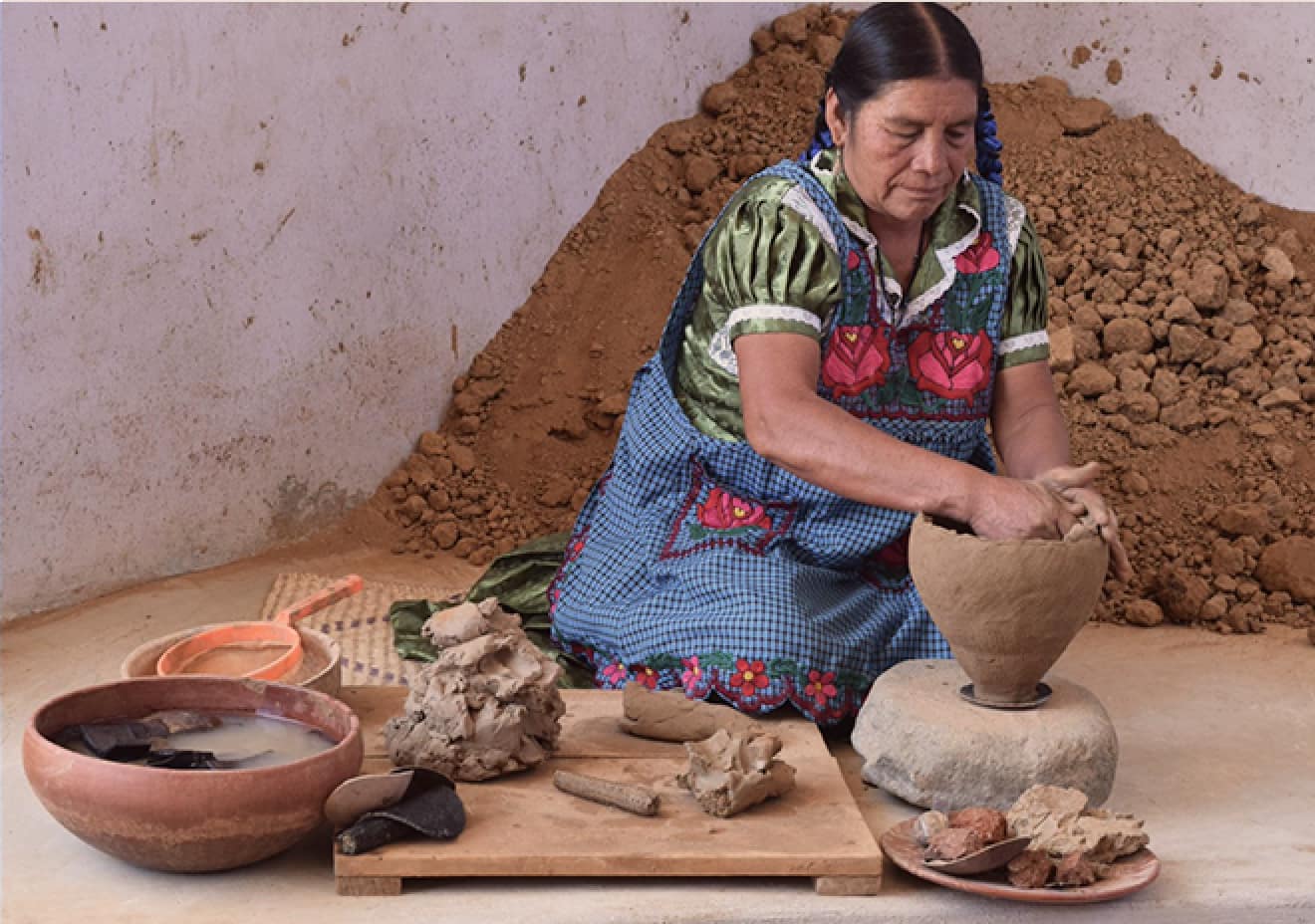
Storytelling in clay has a long tradition spanning more than 20,000 years. For countless centuries, humans have felt the need to express their lives, dreams, and hopes through clay.